

Why You Keep Revising the Same Song
(System)
Endless revision often looks like dedication, but underneath, it’s usually uncertainty and fear.
Many songwriters and producers get stuck in loops of tweaking small details, rewriting choruses, or endlessly adjusting mixes. Without a clear endpoint, sessions stretch on, creativity feels heavy, and confidence erodes.
This pattern isn’t about laziness or lack of talent — it’s a system-level issue, exacerbated by psychological pressure: the fear of repeating yourself, being judged, or not living up to your own expectations.
Even talented artists fall into this cycle because the creative system they rely on isn’t designed to help them finish.
The Hidden Cost of Endless Revision
Constantly revising comes with emotional and practical consequences:
- Decision fatigue: Every minor adjustment drains energy that could be used for new ideas.
- Loss of confidence: You begin to doubt your instincts, unsure if anything you create is good enough.
- Emotional attachment without closure: Songs stop being tools for expression and start feeling like personal tests, tying your self-worth to each note.
Example: A songwriter spends hours rewriting the same bridge, tweaking phrasing for the tenth time. Each change feels “necessary,” but by the end, momentum is gone, excitement is dead, and other projects suffer.
Why Systems Are the Real Solution
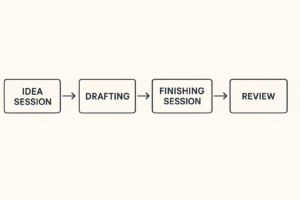
The problem isn’t perfectionism — it’s a lack of clear systems to guide when a song is truly done. Systems protect both your workflow and your mental state:
- Reduce friction: Know exactly when a project is “complete,” so you don’t waste time deciding.
- Protect confidence: Limiting revisions stops self-doubt from snowballing.
- Preserve energy: Less time spent on endless loops means more time for new ideas.
When systems are missing, creatives often compensate with overthinking. When systems exist, the same perfectionist tendencies can be harnessed productively rather than holding you back.
System Rules That Free Creativity
Here’s a framework to stop overthinking and start finishing:
-
Define “done” before starting
- Decide on clear completion criteria (e.g., song ready for release, practice, or demo).
-
Limit versions
- Restrict the number of drafts. Example: 3 drafts max for writing, 2 for mixing.
-
Separate idea sessions from finishing sessions
- Experiment and create freely in one session. Focus on refinement in another.
-
Finish quickly, refine later
- Completion comes first; polish comes second. Even a rough version counts as progress.
-
Decouple identity from output
- Your self-worth isn’t tied to the song being “perfect.” Systems allow you to finish without emotional overload.
Finishing builds confidence. Endless tweaking erodes it. These rules don’t remove creativity — they free it.
The Bigger Picture: Why Finishing Matters
Completing songs is about more than output. It’s about momentum, confidence, and creative sustainability. Every finished project, no matter how small, reinforces the belief that you can trust your instincts, make decisions, and keep moving forward.
By applying systems consistently, you reduce emotional friction, protect your Self, and preserve energy for the next idea. This creates a virtuous cycle: the more you finish, the easier it becomes to finish again.
Key Takeaway
You don’t need to overcome perfectionism — you need better systems.
By defining completion, limiting versions, and separating drafting from polishing, you stop endless loops and reclaim both your time and confidence.
Finished songs aren’t just products. They’re proof that your creative infrastructure — Self, System, and Support — is strong, resilient, and ready for the next challenge.