
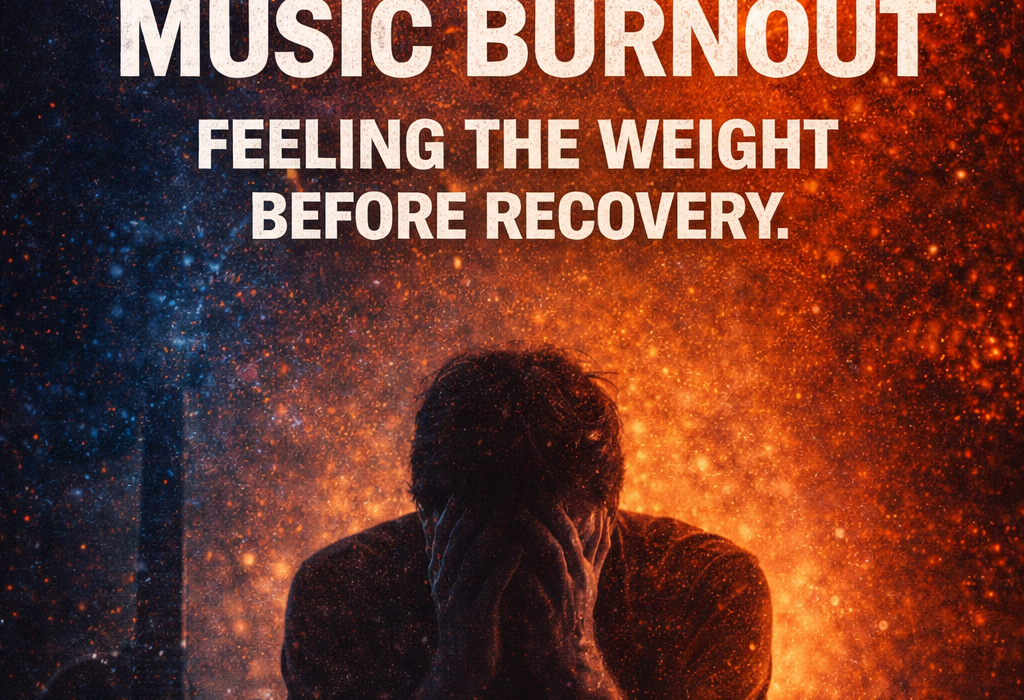
Music Burnout: Feeling the Weight Before Recovery
The Moment You Realize
There’s a moment in the day when you realize it’s not just tiredness anymore. It’s a slow, sinking pressure that sits behind your ribs, tightens in your chest, and hums behind your temples. You open your laptop, pull up your project, and the first note you hear feels like static. The energy you once had — the spark that made melody feel effortless — is now a weight pressing down on your shoulders.
You remember why you started. You remember the excitement of discovery, the thrill of a riff that seemed to come from nowhere, the smile that came when a lyric landed exactly right. But now those memories feel distant, almost like someone else’s life. Your present is a rhythm of deadlines, expectations, and a quiet, gnawing exhaustion that you’ve learned to ignore.
The Creeping Weight of Burnout
Burnout doesn’t announce itself. It creeps. It shows up as forgotten meals, skipped calls, and hours staring at screens while your mind loops through the same thought: “I should be further along. I should be doing more.” You try to push through. You’ve built an identity around persistence, discipline, and the ability to “make it happen.” But persistence is no longer enough. Pushing feels like moving through molasses. Each click, each adjustment, each attempt to generate something new takes five times the energy it once did.
Creativity Feels Hollow
The irony is that you’re still creating. You sit down to a session, and for a moment, something clicks. A chord progression seems right. A lyric almost lands. And then it collapses. The ideas fade before they fully form. The rhythm you once felt in your body, that seamless connection between mind and music, is fractured. You feel fragments of inspiration, but reaching them costs everything. You close the project. You scroll your phone. You scroll again. Nothing sticks.
The Quiet Shame
And inside, there’s a quiet shame. You compare yourself to the others who seem to “have it all together.” You watch peers post new releases, celebrate streams, or share snippets of their latest work. You tell yourself they must not feel it like you do — the emptiness behind the notes, the fatigue beneath the excitement. Maybe they have better systems, better support, better nerves. Maybe they’re just… stronger.
Burnout Is a Signal
But the truth is simpler, and harsher. Burnout is not weakness. It’s a signal. It’s your internal system waving a red flag. It’s saying: something in the environment, in the pace, in the expectation, is unsustainable. The pressure has been rising steadily, almost imperceptibly, and now your nervous system is simply saying: “I cannot hold this any longer.”
The Invisible Cost
And it shows up in subtle, insidious ways. You lose curiosity. You can’t remember why you liked certain sounds. Sessions that once flowed feel like manual labor. You second-guess every choice before it even leaves your mind. Ideas seem hollow. You forget to celebrate small wins because the next task looms larger. Your body carries tension you don’t even notice until your back aches, your jaw clenches, or your sleep fractures.
Isolation magnifies this. Hours spent alone in a studio or bedroom, headphones tight, eyes on the screen — it can feel like you are carrying all the weight. There’s no one to reflect the pressure back, no one to notice the signs you’re ignoring, no one to share even a fraction of the mental load. You begin to internalize every mistake, every missed note, every stalled project. “I should be doing more.” That refrain echoes endlessly.
When Rest Alone Isn’t Enough
You might tell yourself that rest will fix it. But rest alone doesn’t reach the root. Sitting on the couch, turning off the computer, trying to “reset” for tomorrow — it’s temporary relief, a pause in the system’s warning lights. The underlying pressure, the overload, the lack of support, the misalignment between expectation and capacity — it doesn’t vanish. It waits, quietly, until the next session, the next deadline, the next self-imposed expectation.
The Rewiring of Perception
In those long, quiet moments, you start to notice the ways burnout rewires perception. You measure yourself only by output. You conflate activity with productivity. You feel guilty when creativity isn’t constant. You convince yourself that exhaustion is simply part of being “serious” about your craft. And slowly, subtly, you lose sight of the joy that once drew you to music in the first place.
This is what makes burnout so invisible and so dangerous. It doesn’t always explode in dramatic collapse. Often, it whispers. It steals energy. It quiets ideas. It narrows vision. It isolates. And unless you feel it, fully and honestly, you might not realize how pervasive it has become.
Naming It, Feeling It
But feeling it — sitting in it, naming it, allowing yourself to notice it without judgment — is the first step toward reclaiming it. You don’t need to push harder, or pretend everything is fine. You don’t need to chalk it up to laziness or lack of commitment. Burnout is not a character flaw. It is information.
It tells you where your system is leaking. It tells you where the expectations are too high for the infrastructure in place. It shows you the cost of isolation. It illuminates the invisible gaps that have been quietly undermining your creativity for months, maybe years.
A Whisper of Possibility
And when you finally see it, when you allow yourself to feel the full weight of it, something shifts. Not magically. Not immediately. But recognition is the first step. Once you see the pressure, you can start to notice what might support you — not as an external fix, but as a framework that restores balance to your internal world.
A kind word from a peer, a shared reflection, a small structure that helps decisions feel lighter — these are not quick fixes. They are infrastructure. They are what sustains creativity long-term. And even imagining them can give you a sense of relief, a subtle loosening in the chest, a hint of the rhythm you thought was lost.
Sitting With the Shadow
Burnout is not the end of your music, or your career, or your identity as a creator. It is a mirror. It shows you where things are misaligned, where the pace is too fast, where the weight is too heavy, and where support never arrived.
The invitation is simple: feel it. Sit with it. Name it. Let the nervous system whisper its truths without judgment. Before any movement, any action, any rebuilding can begin, you must know where you are breaking.
Reclaiming Music Inside You
Only then, when the weight is seen, acknowledged, and held gently, can a framework emerge that actually sustains you. Not just for the next project, or the next track, but for the entire arc of your creative life.
Burnout is the shadow of unsustainable systems. Recognizing it, feeling it fully, is the first act of reclaiming the music inside you.
Save the Artist
Listening to the Lives Behind the Music
Finding the Music Inside®